When movement feels daunting, start on your terms.
Stiff shoulders or tight hips can make everyday plans feel like a negotiation. BendyBar gives you a gentle place to practice, with resistance and range you control, in 10 minutes a day. A general mobility tool, not treatment or a replacement for your clinician’s advice.
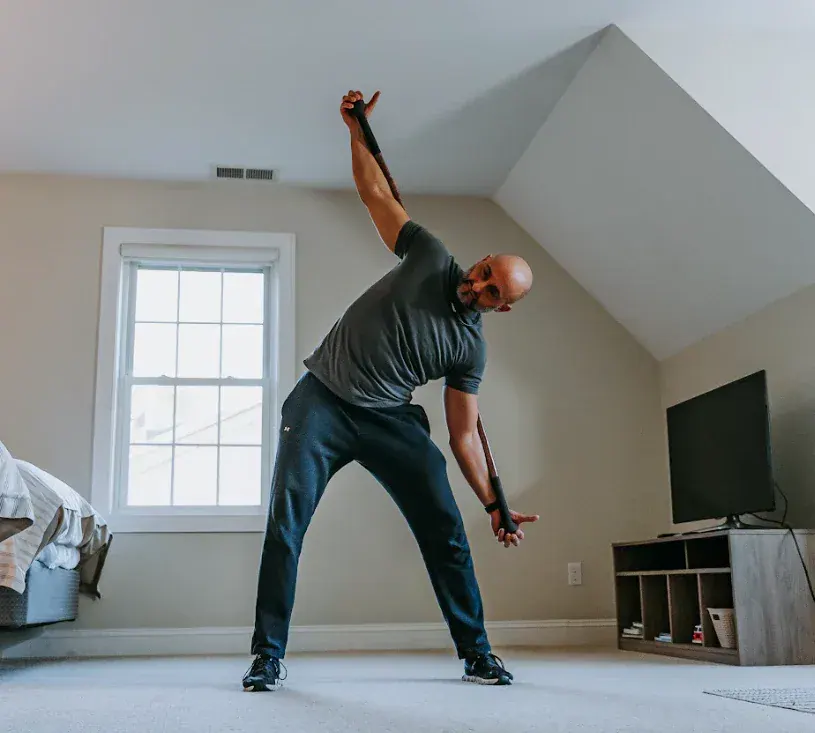
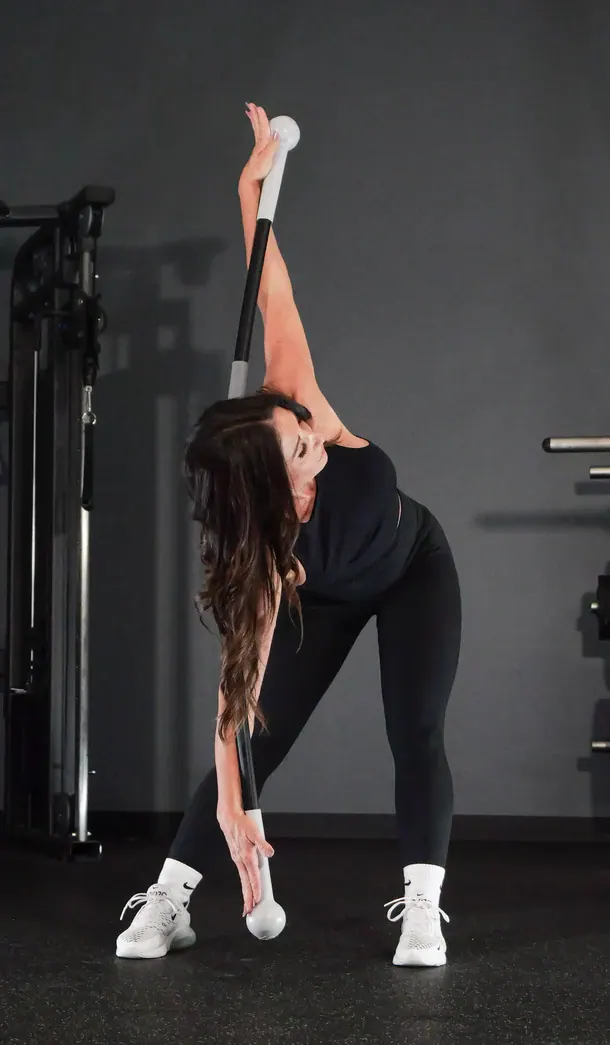
What this actually helps with
Sound familiar? You wake up stiff. You've spent hundreds on PT with slow progress. Doctors keep saying "just stretch more" — but stretching alone doesn't change how you move. Here's what we actually see most often, and where to start:
Shoulder stiffness
Is this you? Reaching overhead feels harder than it used to. Reaching behind your back is worse.
Shoulder stiffness usually shows up quietly — you stop reaching for the top shelf, stop swimming, stop things that used to be automatic. BendyBar's oscillation gives your shoulder controlled resistance through a range you choose, instead of holding a static stretch at the edge of it.
See the Shoulder Mobility Series Guide: Shoulder mobility with an oscillating barHip stiffness
Is this you? Getting up from a low chair takes a beat longer than it should.
Tight hips affect more than your hips — they change how you walk, squat, and how your lower back compensates. This is one of the most common reasons people pick up a BendyBar.
See the Standing Hip Opener Guide: Hip mobility routineGeneral & morning stiffness
Is this you? You wake up stiff and it takes a while to loosen up.
This is the most common starting point. It is not about chasing flexibility for its own sake — it is about a repeatable, low-intensity way to start moving again.
See Gentle Morning MobilityAlso dealing with general lower-back tightness? There is a reason BendyBar can help there too — see the lower back section further down for how and why.
Why clinicians point people here
A tool that responds to you, not the other way round
Dr. JT Anderson, D.C. · Former team chiropractor, Denver Broncos · 31 years in practice · Author, Motion Is Lotion
“I don't endorse many fitness tools. Most equipment is either too rigid, too aggressive, or too complicated for the very people who need movement the most. What drew me to the Bendy Bar is that it doesn't force the body into predefined positions or fixed resistance patterns. Instead, it responds to the user.”
That is the part that matters when you're stiff or cautious: the tool decides nothing for you. How much resistance you create depends entirely on what you give it in that moment, so you can challenge yourself or back off mid-rep without changing equipment.
Read Dr. Gero's full letter (PDF)Read Dr. Anderson's full letter (PDF)More from clinicians
Practice at your pace
Three gentle phases. One repeatable routine.
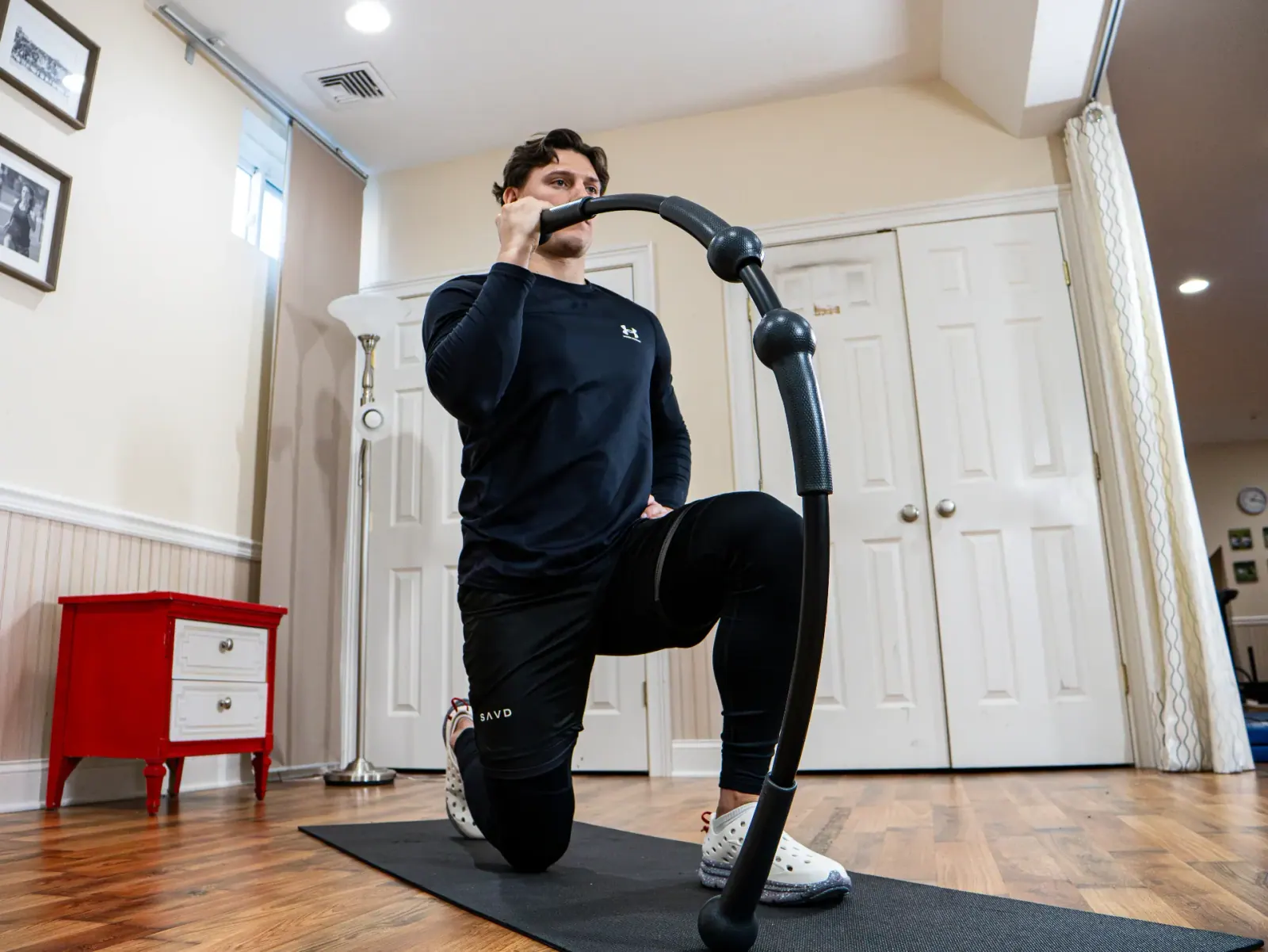
1
Start · Find a comfortable range
Five minutes of low-intensity oscillation in the morning. The goal isn't strength, it's giving your joints an easy, controlled way to start moving for the day.
- 0–30 lb Light bar, pressure you control
- Gentle range of motion for back, hips, shoulders
- Practice comfortable standing positions
2
Repeat · Make room for practice
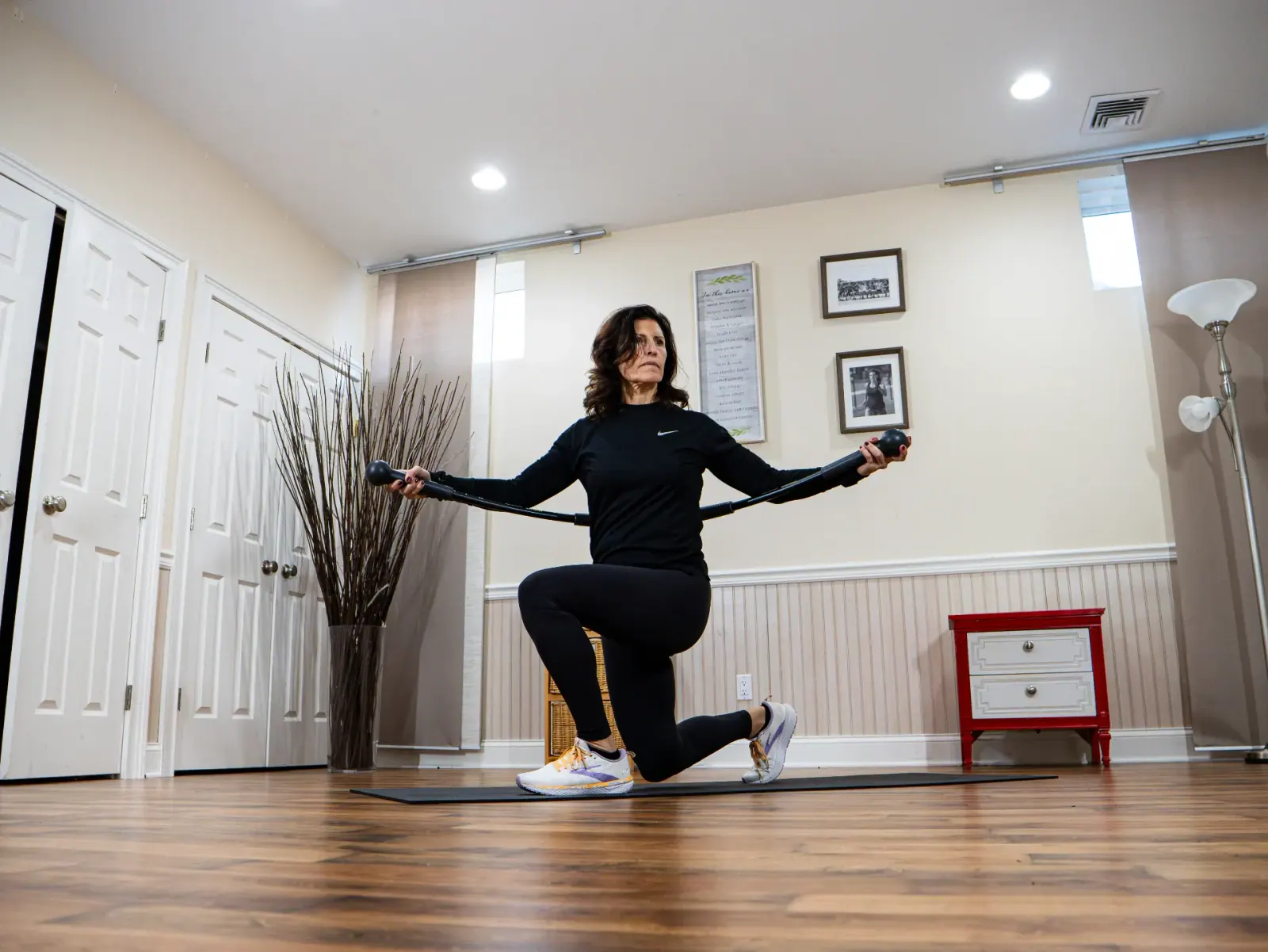
Add midday and evening sessions. This is where the deep stabilizer muscles get the most consistent work, at a level you control.
- Hip and shoulder stability practice
- A routine that is easy to keep repeating
- Adjust effort to how you feel today
3
Personalize · Keep your why in view
A walk, time in the garden, playing with the grandkids: your reason to move is personal. Choose a routine that fits your day and follow your clinician’s guidance if you have pain or an injury.
- Daily ritual you actually look forward to
- A routine connected to what matters to you
- A daily habit you actually keep
From someone using it daily
A ten-minute routine, in her own words
Press play to hear her describe her own morning routine. We have not added a written quote here because we only publish wording people actually said.
In their own words.
1-year warranty on every bar
Free standard shipping on bundles (contiguous U.S.)
Secure checkout, real human support
How BendyBar compares to other mobility tools
Not sure if this is the right kind of tool for you? Here's the honest breakdown.
| If you're using… | What it does | Where it falls short |
|---|---|---|
| A rigid bar or PVC pipe | Gives you something to hold and move against | Doesn't conform or flex, so it can't meet you where your range actually is |
| Static stretching | Asks your tissue to tolerate a held position | Doesn't build control at the edge of your range, the part people trust least |
| A resistance band | Adds load that increases the further you stretch it | Backwards for gentle work: the hardest part is exactly where you're most guarded |
| A foam roller | Helps with soft-tissue tension and circulation | Passive, so it doesn't train the stabilizing muscles that keep a joint feeling steady |
| BendyBar | Oscillating resistance that scales with how far you bend it | You control intensity moment to moment and can back off mid-rep, so it's built for working actively through range |
Start on the Light bar, roughly a 0 to 30 lb range, and move up only once your current sessions stop asking anything of you.
Pick your starting point
Start gentle. Progress at your pace.
Most pain & rehab users start with the Light Bar, gentle enough to use daily and easy to control.
$318.40
$398.00
Save $79.60The Complete System
Choose Your Bundle
Most customers start with 2 bars, the next resistance is ready the day you outgrow the first.
Choose your 2 bars
Medium + Medium is the standard pair. Mix in Light if you want a gentler entry bar.
Medium + Medium
Bar 1
0–45 lb
Bar 2
0–45 lb
- 2 BendyBars. Choose any 2 resistance levels
- Start gentle, then progress when ready
- Full Exercise Library
- Free standard shipping on bundles (contiguous U.S.)
- 1-Year Manufacturer Warranty
Free Standard Shipping
On bundles in the contiguous U.S.
Your Resistance Mix
Choose the level of every bar.
Routine Library
Full library and Daily Reset included.
Real Humans
Email or chat support, 7 days a week.
Rebuilding range when everything feels stiff
People often arrive here after a long quiet stretch: an injury, a surgery, a busy year, or simply a decade of sitting. Positions that used to be automatic now feel guarded, and the usual advice to just stretch more rarely holds.
The BendyBar is a general mobility and training tool built around a flexible, asymmetrical shaft. As you move, the bar loads and rebounds, so you work through a range against tension that never spikes. That may help you rebuild confidence in a position gradually rather than forcing it.
This tends to suit you if
- You are easing back into movement after time away
- Stiffness is what you notice most during the day
- Floor work is awkward or uncomfortable to get into
- You have been given exercises and want a tool that makes them repeatable
- You want to start gently and progress on your own timeline
What people work toward
- Ten minutes of standing mobility that fits into a normal morning
- More control at the edges of your range, not just more range
- Reaching overhead and rotating without bracing for it
- A routine you can show a clinician and adjust with them
- Progressing resistance only when the current level feels easy
Why oscillating resistance suits gentle work
A static stretch asks tissue to tolerate a position. A resistance band adds load that increases the further you go, which is exactly backwards when the end of your range is the part you trust least.
Oscillating resistance behaves differently. The bar's load is a function of how far you bend it, so you control the intensity moment to moment and can back off inside a rep. Working actively through a range, rather than hanging out at the end of it, supports the stabilizing muscles that keep a joint feeling steady.
Start on the Light bar, which covers roughly a 0 to 30 lb range, and move up only when the sessions stop asking anything of you.
Weighing it against a leverage-style mobility stick? Read the independent BendyBar vs Stick Mobility comparison.
Start with these routines
Gentle morning mobility
The lowest-intensity entry point on the site, all standing.
In the routine: Standing side bends, gentle rotations and overhead reaches, five to ten minutes.
Standing hip opener
Hip range without getting down onto the floor.
In the routine: Supported split stance, hip circles and controlled lateral shifts.
Shoulder mobility series
A conservative, graded shoulder progression.
In the routine: Low-range presses, external rotation holds and slow overhead reaches.
The full exercise library
Written routines and follow-along video, included with every bar.
Worth reading first
What about lower back tightness?
Lower back tightness is the most common thing people write to us about, and it is also the one we are most careful with. Two things are worth knowing.
First, the lower back is often where other stiffness shows up. When hips do not rotate or extend well, the lumbar spine tends to take up the slack, so hip mobility work is frequently where a back-focused routine actually starts. Second, a back that feels tight often responds to being asked to hold a position under light, controlled load rather than being stretched harder — which is what anti-extension core work is for.
What we do not claim: BendyBar does not treat back pain, does not fix a disc, and is not a diagnosis or a substitute for a clinician. If your back pain is severe, worsening, or comes with numbness, weakness or changes in bladder or bowel function, see a professional rather than starting a routine.
Core anti-extension circuit
Light, controlled bracing work rather than more stretching.
In the routine: Standing anti-extension holds and slow presses with the bar in front.
Standing hip opener
Hip range first, because the lower back often compensates for it.
In the routine: Supported split stance, hip circles and controlled lateral shifts.
Questions people ask before starting
Is the BendyBar a medical device?
No. It is a general training and mobility tool. It is not intended to diagnose, treat, cure or prevent any condition. If a clinician is managing an injury or condition, check with them before adding anything new.
Which resistance level should I start on?
Light, roughly 53 to 59 inches with a 0 to 30 lb range. It is the gentlest option and the load still scales with how far you bend the bar, so there is room to grow inside it.
How long should a session be?
Ten minutes is the target most routines are built around. Consistency matters far more than duration, and short, consistent sessions are easier to repeat than an occasional long session.
Do I need to get on the floor?
No. The routines recommended above are standing or half-kneeling and need nothing but the bar and a few feet of clear space.
What if it does not suit me?
Every bar ships with the full routine library and a 1-year manufacturer warranty. Returns follow our published refund policy, and damaged or incorrect items are always made right.
What if my pain is severe or getting worse?
Then a mobility tool is not the right next step. Severe, worsening or unexplained pain should be looked at by a clinician first. BendyBar is a general mobility tool for people working on range of motion and control, and it is not a substitute for care.
Start gently, progress on your terms
The Light bar plus the full routine library, with free standard shipping on bundles in the contiguous U.S.
See resistance optionsKeep exploring
10 minutes. That's the ask.
A small step. On your terms.
You don’t have to force a stretch or prove anything. Choose a comfortable starting point and make 10 minutes a day your own.
A general mobility tool, not a medical device.
BendyBar is built for people rebuilding range of motion and confidence in movement. It is not intended to diagnose, treat, cure or prevent any condition. If a clinician is currently managing an injury or condition for you, it is worth checking with them before adding anything new. Most of our users tell us that is exactly why they like it: something to repeat what their PT already gave them, not replace it.